
Pies by Copperthite make historic return to Georgetown
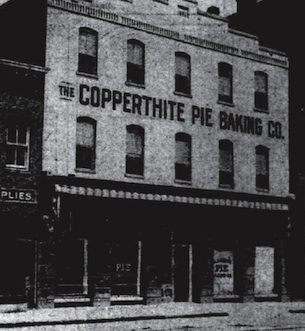
In 1886, Henry and Johanna Copperthite came to Georgetown on the eve of Thanksgiving and started baking pies. By 1914, they were baking 60,000 pies a day in Washington, D.C. Their pies were declared the finest in all of America. In 2012, the Copperthite family plans to return to Georgetown to open a pie company right here. The Georgetown Dish welcomes the return of the family spirit, captured in the voice of its patriarch Henry Copperthite:

Cupcake sisters. Pie girls. Baked and Wired. It’s interesting to me, watching what is going on in 2011 in my old hometown, West Washington.
My name is Henry Copperthite, and I’m from Connecticut originally, but joined the 79th Highlanders of New York and came to Washington during the War Between the States and was stationed at Georgetown College in 1861. The name Copperthwaite is from a family who gave much to this country. Some were indentured servants who were released after the slaves in Antigua in 1844. I returned to Connecticut after the war where I had been a wagon driver for a bakery, and spent the next 20 years learning the production side of the business.
But I liked what I had seen as a sentry during the war, stationed at what is now Georgetown University. Farmland, hills rolling down to the river, farmhouses dotting the landscape. I liked it so much I brought my wife here for our honeymoon in 1870, and we decided it would be a good place to return to start a business. So, on Thanksgiving eve in 1885, with a horse, a wagon, $3.50 and a lot of knowledge about the baked goods business, we moved to Georgetown. And we started baking pies!
So why am I stirring from my comfy digs in Oak Hill Cemetery to author an article?

I have a few reasons. Thanksgiving is coming up shortly, exactly when my wife and I moved here, 126 years ago. Secondly, with the cupcake and pie craze here, I thought it was about time to lay down a little history. Add to that the fact that you’re digging up half of the streets in the West Village, dating back over 100 years – and, well – you’re stirring up history, so I decided to tell my story as well.
We started baking pies the moment we arrived, and quickly were turning a profit on a daily basis of $100, in today’s money. 25 years later, the Connecticut Copperthite Pie Company was baking and selling over 50,000 pies a day in Washington.
That’s right – 50,000 pies a day. I understand that is a bit hard to believe, so I’ve dug up lots of old newspaper articles and pictures. It helps to understand that in the late 1800s and early 1900s, it was at a time when shopping for groceries and the delivery of fresh baked goods was in its infancy, and it was a novelty for the woman of the house to be able to buy something already prepared. We sold wholesale to markets - thousands of pies a day - and we also started delivering to the White House, Congress and the Supreme Court. But here in Washington, on average, every man, woman and child ate two of my pies every seven days. Maybe now when you see the people lined up on the sidewalk for cupcakes, this will put it in perspective.
Quality control in my time meant producing your own ingredients. We produced 29 different types of pies – meat, fruit and vegetable. In 1900, I purchased a 600 acre farm and structure at Burke Station, VA and started a dairy farm to provide milk and butter for our pies. I also purchased over 5,000 acres in Loudoun County for the production of fresh fruit and vegetable ingredients. A portion of this farm is part of what is now Runnymede Park in Herndon. I acquired land in Rock Creek Park, several lots in Georgetown and throughout the city of Washington. I even owned Analostan Isloand, which later became Teddy Roosevelt Island.

But it wasn’t just about the pie business and all the farmland, dairies and orchards. We built factories on Capitol Hill, Bridge Street (M today, across from Dean and Deluca), and at High and O street (Wisconsin and O). Most people don’t know this, but before the War Between the States, a slave pen stood at the site of the factory at Wisconsin and O streets (now where the CVS is).
We also built houses, 3337 N Street NW and 14 other houses in the West and East Village. I was a founding board member of the Potomac Savings Bank at Wisconsin and M, we were very active in St. John’s on O street (as evidenced by the pages of births, deaths and baptisms recorded in church history), and I served on Georgetown’s Planning Board and many charity organizations, including protective services of children in the workplace, and animal rights organizations.
I’ve got lots more Washington history to share having to do with racetracks and race horses, inventions and – hey, the current location of the Ritz Carlton Hotel today is South Street, but until the 1980s, it was called Copperthwaite Lane. I’ve uncovered some amazing glass negatives from the National Archives with photographs that have not seen the light of day for over 100 years. And I’m happy to share them with my readers in upcoming columns.
For now, enjoy Pie with your Thanksgiving meal, and think of me, Henry Copperthite, the original Pie King of Washington, D.C!
